Smart sunscreen control: better indoor climate & lower energy utilization
Sunscreen control is an effective and often necessary way to keep the sun’s heat out and reduce the need for cooling. With the right sunscreen control and smart control, Lindinvent can also make use of daylight and solar energy when they are beneficial.
By combining external factors such as the intensity and position of the sun with sensors on the inside of the window, Lindinvent can control the sunscreen control with the aim of minimizing energy utilization and maximizing occupant well-being. The control can provide more daylight and a better view without unnecessary glare, and through LINDINSPECT® the solution is easy to monitor and manage through an intuitive web interface.

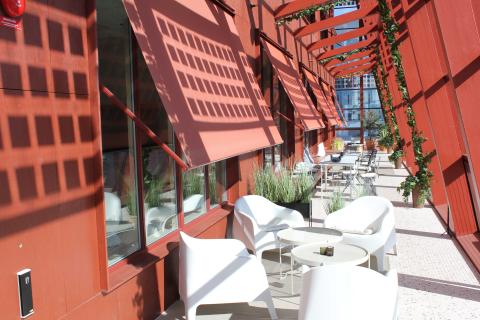
Why should you have smart sunscreen control?
Smart sunscreen control is not only about preventing sunlight from entering. It affects comfort, temperature, daylight, glare, energy, operability and sustainability. With the right control, sunscreen control can also help limit visibility into the building and make entry through windows more difficult.
Heating and cooling – use the sun when it is beneficial
The sun provides both heat and light, which should be utilized when appropriate. The weather station provides the system with information including light intensity, heat output per square metre, temperature, humidity and wind speed.
- During the summer months, the sunscreen control can block solar heat to keep the temperature down and reduce the need for cooling.
- During the winter months, the sun can instead be used as a free source of heat and light, provided that it does not cause glare.
- If a room requires heating and the presence/occupancy detection indicates that the room is empty, the sunscreen control can allow solar radiation to heat the room.
- When the premises are empty, lowered sunscreen control can also, depending on its design, slightly improve the U-value of the window section.
Daylight, views and glare protection
Different types of sunscreen control provide different conditions for views and glare protection. Fabrics often limit the view more than venetian blinds when the sun is relatively high. When the sun is low, the venetian blinds need to be angled further, which also affects the view.
Fabrics that provide some transparency do not always offer complete glare protection and may therefore need to be supplemented with internal glare protection. At the same time, the sunscreen control is part of the building envelope and must therefore balance views, glare protection and heat reduction.
Lindinvent’s control system can optimize the angle of the venetian blinds for maximum views and minimum solar heat gain. With daylight-compensated lighting, greater use of available daylight can also reduce the need for electric lighting.
Using an IFC model of the building, a 3D-based shadow calculation can show which windows are exposed to the sun or are in shade on different days of the year. Windows that are already shaded do not require sunscreen control to the same extent, which can provide a better view.
For fabrics, the desired openness factor can be set to provide a better view, provided that the glass can withstand this without a risk of thermal stress and that the solution is suitable from an energy perspective.
Automatic control – with the option of individual adjustment
Occupants may experience improved well-being when they can operate the sunscreen control themselves. Automatic control can therefore be combined with individual operation.
Lindinvent can offer several ways to control the sunscreen control:
- wired switches
- wireless and battery-free switches for flexible placement
- app-based adjustment, where the user scans a QR code and adjusts the sunscreen control as desired in the app
Weather-protected sunscreen control
The weather station values are used not only to control the sunscreen control optimally, but also to protect the hardware.
At excessively high wind speeds, the sunscreen control is raised. The same applies at excessively low temperatures.
Interaction with the fire safety function
If a fire is indicated, or if a monitored signal is absent for a certain period, the sunscreen control must be raised so that the windows are freely accessible from both inside and outside.
Limited visibility and burglary protection
At the end of the day, when the premises have been vacated, the sunscreen control can be lowered to limit visibility into the building. This makes it more difficult to see what is inside.
Venetian blinds in front of the windows can also make it more difficult to enter through the window.
Roller blind, screen, venetian blind or awning – intelligent control for different needs
Roller blinds, screens, venetian blinds and awnings have different characteristics and provide different conditions for views, glare protection and heat reduction. The most suitable type therefore depends on the conditions of the building and the room.
Approximate heat reduction:
External venetian blind: ~80–90 %
External screen: ~75–85 %
Venetian blind between the panes: ~55–65 %
Metalized internal roller blind: ~35–55 %
Internal roller blind, non-metalized: ~20–40 %
Roller blind / screen
Fabrics can provide some visibility, but the degree of transparency also affects glare protection. In some cases, internal glare protection may be required as a supplement.
Venetian blinds
The slat angle of the venetian blinds can be optimized to provide the best possible view while limiting solar heat gain.
Awnings
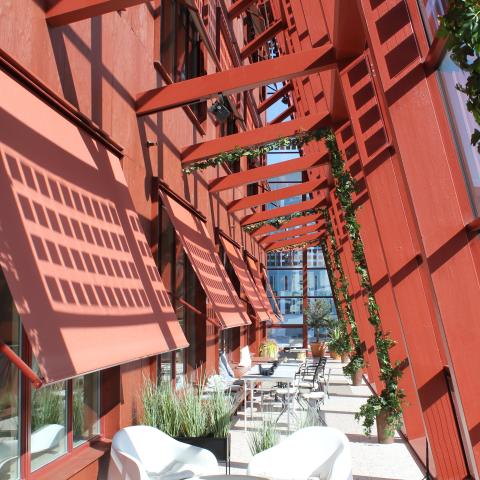
Awnings are one of the types of sunscreen control that can be included in the intelligent control system.
Internal or external?
Type and placement affect the conditions for views, glare protection and heat reduction.
Sunscreen control adapted to demand
The sun’s impact on a building changes throughout the day and the year. With automatic control, the sunscreen control can be adjusted to current conditions instead of remaining in the same position regardless of whether the sun reaches the facade.
Lindinvent can control motorized sunscreen control and allow the control system to interact with other room-level functions. The control system can combine outdoor conditions, such as solar intensity and temperature, with information from the room, such as occupancy and room temperature.
Part of the room control system
Sunscreen control is not an isolated function – it can be part of the integrated control of the room. By allowing the sunscreen control to interact with ventilation, heating, cooling and lighting, the control system can be based on the room’s actual conditions and use.
What types of sunscreen control can we control?
Lindinvent can control motorized sunscreen control such as roller blinds, screens, venetian blinds and awnings.
The control is adapted to the technical conditions of the current solution and to how the sunscreen control should operate together with the room’s other systems.
Automatic sunscreen control
With automatic control, the position of the sunscreen control can be adjusted to current conditions instead of requiring the user to adjust it manually during the day.
The control system can take into account factors including solar intensity, outdoor temperature, room temperature, occupancy and information about how the sun affects the building’s different facades and windows.
Individual control
Automatic control does not have to mean that the user loses the ability to influence the local environment.
The user can be given the option to adjust the sunscreen control in the individual room while the system manages the overall automatic control.
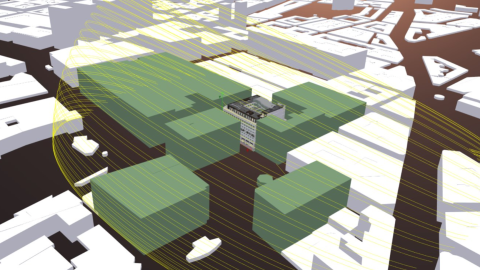
The right sunscreen control starts before the building design is finalized
Using shadow calculations and shadow studies, we can analyse how solar radiation affects a building at different times of day and during different parts of the year. The study provides valuable information for determining where sunscreen control is needed and how the control system should be designed.
To achieve the greatest possible benefit, the shadow calculation should be carried out early in the construction process. The aim is for the shadow study to be completed before the design of the building’s sunscreen control and control system begins, so that the results can be used as an actual design basis.
From shadow study to completed installation
1. Shadow study
The building’s sun and shade conditions are analysed.
2. Design
The result is used as a basis when the solution is designed.
3. Installation
The sunscreen control and control system are installed in the building.
4. Commissioning
The system is configured and commissioned.
The study and calculation
Using the building’s IFC model and information about surrounding buildings, we can analyse how shadows fall on the building’s windows on different days and at different times of the year.
The calculation is performed at 15-minute intervals and provides a detailed basis for the control system. This allows the system to take into account whether an individual window is exposed to sunlight or shaded when determining the position of the sunscreen control.
Why perform a shadow calculation?
The shadow study should be carried out as early as possible in the project, before the sunscreen control solution has been finalized. The result can then be used as an actual design basis and help determine where sunscreen control is needed and how the control system should be designed.
By clarifying which windows are exposed to direct sunlight and which are shaded by surrounding buildings, it becomes easier to adapt the solution to the building’s actual conditions. At the same time, this reduces the risk of sunscreen control being installed where the need is limited or non-existent.
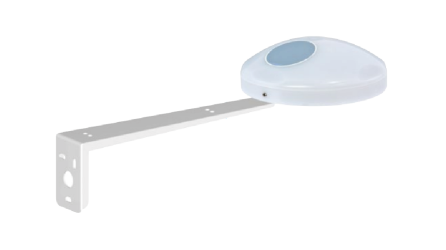
The weather station detects the conditions
WSC11 is installed outdoors and provides the system with current information about weather and light conditions: light intensity, heat output per square metre, temperature, humidity, air pressure, wind speed, wind direction and precipitation.
Information from the weather station is used together with the shadow calculation to adapt the sunscreen control to the current conditions at the building’s different facades.
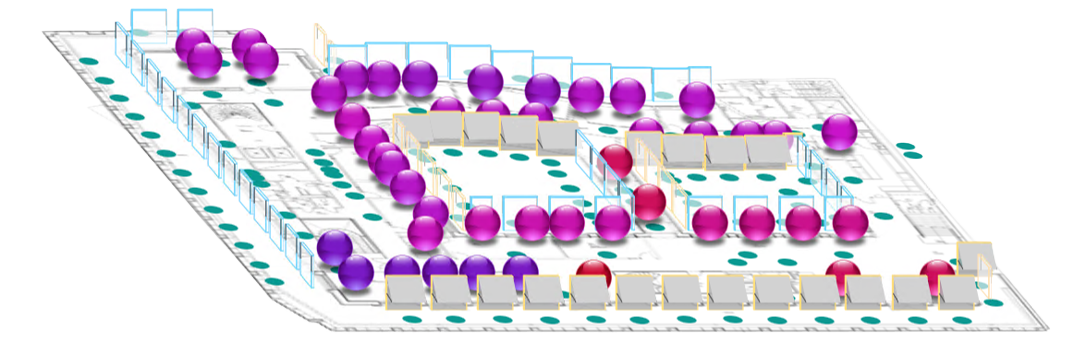
Sunscreen control visualised in LINDINSPECT®
Example of visualisation in LINDINSPECT® with sunscreen control in the form of articulated-arm awnings. The image is from Skären in Stockholm.
CASE
Smart sunscreen control in Fyrtornet
At Fyrtornet in Hyllie, the sunscreen control is coordinated with the building’s climate system.
The control system takes into account factors including weather, facade orientation and how surrounding buildings shade different parts of the building. At the same time, users can adjust the sunscreen control locally.
Fyrtornet demonstrates how ventilation, lighting and sunscreen control can work together in the same building – from automatic control to the user’s ability to influence the local environment.
Are you planning sunscreen control for a project?
We assist you from design and shadow calculation to control, commissioning and follow-up. Contact us early in the project so that we can review the building’s conditions together.